Tag: god

  • Our Father

    This, then, is how you should pray:

    “‘Our Father in heaven,
    hallowed be your name,

    Matthew 6:9

    This prayer begins where all genuine prayer must begin — with the spirit of adoption: “Our Father.”
    No prayer is truly acceptable to God until we can say from the heart, “I will arise and go to my Father.”

    Once we approach God as His children, we soon recognize His greatness — our Father in heaven — and our hearts are lifted in worship: “Hallowed be Your name.”
    The child who first whispers, “Abba, Father,” grows into one who cries out with awe, “Holy, Holy, Holy.”

    From heartfelt worship, the soul naturally moves to a desire for God’s work in the world: “Your kingdom come, Your will be done on earth as it is in heaven.”
    This missionary longing flows from love and reverence for our heavenly Father.

    Then comes the humble recognition of our daily dependence on Him: “Give us today our daily bread.”
    As the Spirit continues to teach us, we realize that we are not only needy but also sinful, and so we ask for mercy: “Forgive us our debts, as we forgive our debtors.”

    Once we have received forgiveness and know we are accepted through Christ’s righteousness, we then pray for strength to remain faithful: “Lead us not into temptation.”
    A truly forgiven person is careful not to fall again into sin.
    To pray “Forgive us our debts” is to seek justification; to pray “Lead us not into temptation, but deliver us from evil” is to seek sanctification — both the turning away from sin and the pursuit of holiness.

    Finally, the prayer ends in joyful praise: “For Yours is the kingdom, the power, and the glory, forever. Amen.”
    We rejoice that our King rules over all things, both in providence and in grace, and that His kingdom will have no end.

    From the first moment of calling God “Father” to the final expression of worship and trust in His reign, this short model prayer guides the soul through every stage of communion with God.
    Lord, teach us to pray in this way.

  • Give like the ocean

    All streams flow into the sea,
        yet the sea is never full.
    To the place the streams come from,
        there they return again.

    Ecclesiastes 1:7

    Everything under the sky is constantly moving; time itself knows no rest. The solid earth rolls along like a ball, and even the great sun is just a star following its path around some greater light. The tides move the seas, winds stir the air, and friction wears down the rocks—change and death are everywhere. The sea is not a miser hoarding water; just as one force pulls water in, another lifts it away. People are born only to die; life is full of hurry, worry, and anxiety.

    But, friend of the unchanging Jesus, what joy there is in thinking about your eternal inheritance: a sea of bliss that will never run dry, because God himself will pour out endless rivers of joy into it. We look for a lasting city beyond the skies, and we will not be disappointed. The natural world around us can teach us gratitude. Father Ocean is a great receiver, yet also a generous giver. What the rivers bring him, he returns to the earth as clouds and rain.

    A person is out of harmony with the universe who takes without giving back. Giving to others is like planting seeds for ourselves. Whoever wisely uses their resources for the Lord will be entrusted with more. Friend of Jesus, are you giving back to Him in proportion to all you’ve received? Much has been given to you—what fruit have you produced? Have you done everything you can? Could you do more? To be selfish is to be wrong.

    If the ocean kept all its water for itself, it would bring disaster to humanity. May none of us follow the destructive path of living only for ourselves. Jesus did not please Himself. All fullness lives in Him, and from His fullness we have all received. Oh, for the spirit of Jesus, that from now on we may live not for ourselves, but for Him!

  • Give generously

    You expected much, but see, it turned out to be little. What you brought home, I blew away. Why?” declares the Lord Almighty. “Because of my house, which remains a ruin, while each of you is busy with your own house.

    Haggai 1:9

    Stingy people limit what they give to the church and to mission work, calling their tightfistedness “good financial sense.” They don’t realise that by doing so, they are actually making themselves poorer. Their excuse is often that they need to look after their own families—but they forget that neglecting God’s work is the surest way to bring hardship on their own homes.

    God, in His providence, can either bless our efforts far beyond our expectations or frustrate our plans completely. With a simple turn of His hand, He can guide our lives toward success and abundance, or allow us to run aground in poverty and failure. Scripture teaches that the Lord enriches those who are generous, while those who hold back too tightly end up in want.

    In all my experience, I’ve noticed that the most generous Christians I’ve known are also the happiest—and almost always the most prosperous. I’ve seen open-handed givers rise to wealth they never imagined, and I’ve just as often seen the stingy and selfish fall into poverty through the very miserliness by which they hoped to prosper. Just as people trust faithful stewards with greater and greater responsibility, so the Lord often entrusts more to those who give freely. He gives in abundance to those who give generously.

    Even when great wealth isn’t granted, God blesses what little we have, filling it with contentment when our hearts are devoted to Him and when we’ve set apart a portion for His work. Selfishness focuses on one’s own needs first, but godliness puts God’s kingdom and righteousness before all else—and in the end, selfishness leads to loss, while godliness brings great gain.

    It takes faith to give freely to God, but surely He deserves no less from us. Even our greatest generosity is only a small token of gratitude for the vast goodness and mercy He has shown us.

    “Father God. I thank you that are a generous God who delights in pouring out good gifts onto his children. I thank you for the gift of your life on the Cross, for the gift of your Holy Spirit who’s constantly teaching me your ways and every other lavish gift you’ve bestowed on me. Help me to be generous in the same Spirit, help me to be a cheerful giver, help me to put your Kingdom and helping others beyond my own needs. And as I give I trust that you will continue to give to me so that I give and give again. Amen

  • Take heart baby Christian

    Brothers and sisters, I could not address you as people who live by the Spirit but as people who are still worldly—mere infants in Christ.

    1 Corinthians 3:1

    Are you feeling sorrowful, believer, because your spiritual life feels weak—because your faith seems small and your love faint? Take heart, for you still have every reason to be thankful. Remember that in many ways, you stand equal with the strongest and most mature Christian.

    You have been bought with the same precious blood as they have. You are just as much a child of God as any other believer. A newborn child is just as truly a son or daughter as a full-grown adult. You are just as fully justified before God, for justification doesn’t come in degrees—your small faith has made you completely clean.

    You have the same right to the blessings of God’s covenant as the most spiritually advanced believer, for that right depends not on your maturity, but on the covenant itself. Your faith in Jesus is not the measure of your inheritance, but the sign of it.

    You are as truly rich in Christ as the richest saint—if not yet in experience, still in possession. The smallest star in the sky belongs to the heavens just as much as the brightest one; the faintest ray of light is still of the same nature as the sun. In God’s book of life, the great and the small are written with the same pen.

    You are just as dear to your Father’s heart as the greatest in His family. Jesus is deeply gentle toward you. You may be like a smoldering wick—some would snuff it out because it gives off an unpleasant smell—but He will not quench it. You may be like a bruised reed—others might break or discard you—but He, the Master Musician, will never do so.

    So rather than being discouraged by your weakness, take joy in Christ.
    Am I small among God’s people? Yet in Christ, I am seated in heavenly places. Am I poor in faith? Still, through Jesus, I am heir of all things. Though I have nothing in myself to boast of, if the root of faith is truly in me, I will rejoice in the Lord and glory in the God of my salvation.

  • The throne of grace

    You crown the year with your bounty,
        and your carts overflow with abundance.

    Psalm 65:11

    Many of the Lord’s “paths” overflow with blessing, but one of the most special is the path of prayer. No believer who spends much time alone with God will ever have to cry, “I am weak and empty; woe is me.”

    Those who stay far from the throne of grace become spiritually starved, like dry fields in a season of drought. But those who wrestle earnestly in prayer grow strong in the Lord—if not always joyful, at least deeply strengthened.

    The place closest to heaven’s gate is found at the throne of grace. Spend much time there, and your faith will become firm and full of assurance. Spend little time alone with Jesus, and your faith will be shallow, troubled by doubts and fears, and lacking the joy of the Lord.

    Since the rich and nourishing path of prayer is open even to the weakest believer—since it requires no great spiritual achievement, and since the invitation to come is freely given to every saint—see to it, dear reader, that you make private prayer a regular habit. Be often on your knees, for it was through prayer that Elijah brought rain to the drought-stricken land of Israel.

    There is another path filled with blessing for those who walk in it—the secret path of communion with Christ. Oh, the sweetness of fellowship with Jesus! No words on earth can describe the holy peace of a soul resting on His heart.

    Few Christians truly experience this. Many remain in the lowlands of faith, rarely climbing the heights of spiritual closeness. They stay in the outer court and do not enter the holy place; they do not live out their privilege as priests before God. From a distance they behold the sacrifice, but they do not sit down with the priest to share in it or to taste the richness of the offering.

    But you, reader, stay ever near to Jesus. Rest under His shadow; reach up and take hold of the branches of that palm tree. Let your Beloved be to you as the apple tree among the trees of the forest, and your soul will be filled and satisfied with His goodness. O Jesus, visit us with Your salvation!

  • Godly sorrow

    Genuine, spiritual sorrow for sin is the work of the Holy Spirit. True repentance is too rare and precious a flower to grow in the garden of human nature. Pearls may form naturally in oysters, but repentance never appears in the heart of a sinner unless God’s grace produces it there. If you have even the smallest amount of real hatred for sin, it is because God has given it to you, for human nature alone—like a thornbush—can never produce good fruit. As Scripture says, “That which is born of the flesh is flesh.”

    True repentance always looks to the Saviour. When we repent, one eye must be fixed on our sin and the other on the cross—or better still, both eyes should be fixed on Christ, seeing our sins only in the light of His love and sacrifice.

    Real sorrow for sin is practical, not just emotional or theoretical. No one can truly say they hate sin while continuing to live in it. Repentance makes us see sin’s evil through experience—just as a burned child fears fire. We become as cautious toward sin as a man who has recently been robbed is wary of thieves. We avoid it completely—in both great and small things—just as people avoid little vipers as much as great serpents.

    True mourning for sin makes us careful with our words, lest we speak wrongly. It makes us watchful over our daily actions, lest we offend in anything. Each night we end the day with humble confession of our failures, and each morning we begin with earnest prayer that God would keep us from sinning against Him.

    Sincere repentance is lifelong. Believers repent until their final breath. This well of godly sorrow never runs dry. Every other sorrow fades with time, but this precious sorrow grows as we grow, and though it is both sweet and painful, we thank God for allowing us to experience it until the day we enter His eternal rest.

  • The ways of the Lord

    There are times when being alone is better than being with others, and when keeping silent is wiser than speaking. We would be stronger Christians if we spent more time in solitude—waiting on God and drawing spiritual strength through meditating on His Word, so we can serve Him more faithfully.

    We should reflect deeply on the things of God, because that is how we truly draw nourishment from them. Truth is like a cluster of grapes on the vine: if we want the wine, we must press and crush the grapes; we must work them again and again.

    The one who treads the grapes must do so eagerly and thoroughly, or the juice will not flow freely, and much will be wasted. In the same way, we must meditate on the truths of Scripture—pressing them in our hearts—if we are to receive from them the wine of comfort and joy.

    Just as our bodies are not sustained merely by eating food, but by digesting it—turning it into strength for muscle, nerve, and bone—so our souls are not nourished merely by hearing or reading the Word. Listening, reading, marking, and learning are all important, but their true value comes when we inwardly digest what we take in, and that happens through meditation.

    Why is it that some Christians, though they listen to many sermons, grow so little in their spiritual lives? It is because they neglect time alone with God and do not thoughtfully reflect on His Word. They love the grain but will not grind it; they desire the corn but will not go to the fields to gather it; the fruit is within reach, but they do not pick it; the water flows beside them, but they will not stoop to drink.

    Save us, Lord, from such foolishness. Let this be our resolve today: “I will meditate on Your precepts.”

  • Strength from God

    All the strength that our gracious God gives us is meant for service — not for self-indulgence or pride.

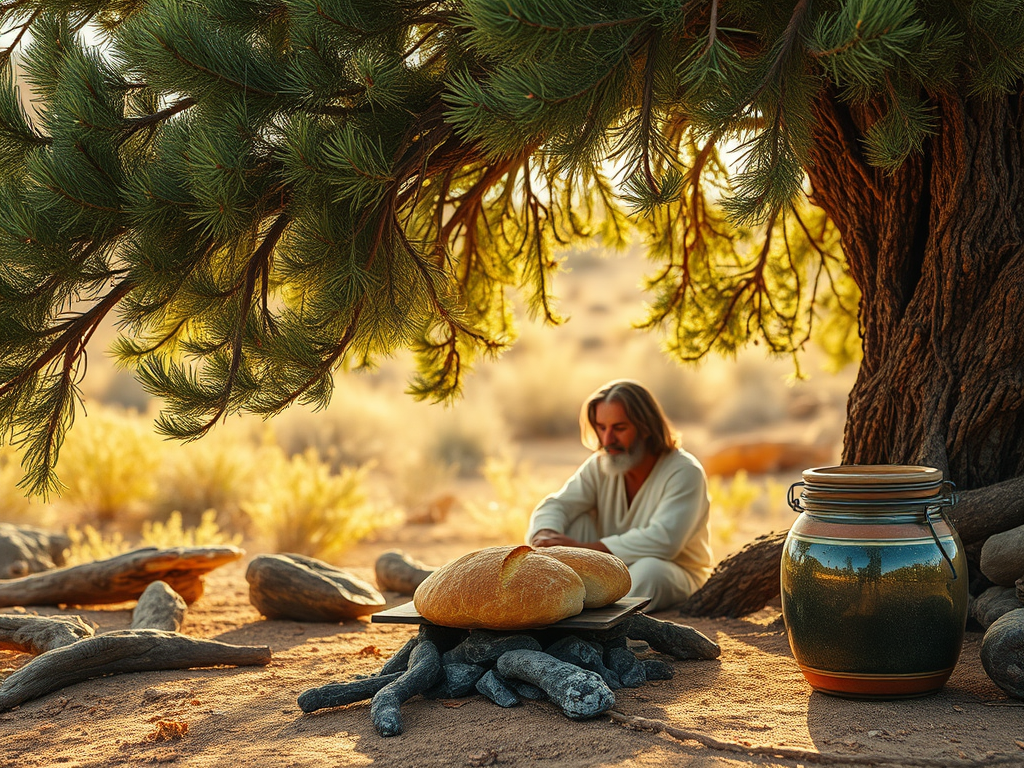
    When the prophet Elijah found the bread baked on the coals and the jar of water by his head as he rested under the juniper tree, it wasn’t a luxury meant for his comfort. Rather, God gave it so he could journey forty days and nights to Mount Horeb, the mountain of God.

    In the same way, when Jesus invited his disciples to “Come and dine” with him, the meal was followed by a command to Peter: “Feed my sheep,” and then, “Follow me.” Likewise, we are nourished with the bread of heaven so that we might use our strength in serving Christ.

    When we come to the Lord’s table, we eat with readiness—our loins girded and staff in hand—prepared to go wherever he sends us once we’ve been fed. Yet some Christians are eager to live on Christ, but not as eager to live for Christ.

    This life on earth should prepare us for heaven. And heaven itself is a place of both feasting and serving. There, the saints dine at the Lord’s table and serve him day and night in his temple. They are nourished with heavenly food and give perfect service in return.

    Believer, use the strength you receive from Christ each day to labor for him. Many of us still have much to learn about the purpose for which God gives his grace. We are not meant to store up the truth, keeping it unused like the grain found sealed in Egyptian tombs for centuries. We are to plant it, nurture it, and let it bear fruit.

    Why does the Lord send rain on the dry earth and the warmth of the sun? It is so that the earth may bring forth food for humankind. In the same way, God refreshes and strengthens our souls so that we might use that renewed strength to bring glory to him.

    Charles Spurgeon

  • Jesus Christ – Our advocate!

    If anyone sins, we have an advocate. Yes—even though we sin, we still have Him. John does not say, “If anyone sins, he loses his advocate,” but rather, “we have an advocate,” even though we are sinners. No sin a believer has committed, or will be allowed to commit, can take away their standing in the Lord Jesus Christ as their advocate.

    The name given to our Lord here is meaningful: “Jesus.” That tells us He is exactly the kind of advocate we need, because the name Jesus means “Savior”—the one whose work and delight is to save. As Scripture says, “They shall call His name Jesus, for He will save His people from their sins.” Even His very name promises His success.

    Next, He is called “Jesus Christ”—Christ meaning “the Anointed One.” This shows His authority to plead for us. Christ has the right to be our advocate because He is the Father’s own chosen and appointed High Priest. If we had chosen Him ourselves, He might fail us; but since God has laid help upon One who is mighty, we can safely place our troubles where God has placed His help. He is Christ, and therefore authorized; He is Christ, and therefore fully equipped, because His anointing has perfectly prepared Him for His work. He can plead in a way that moves the heart of God and prevails. What tender words, what persuasive sentences will the Anointed One use when He stands to plead for me!

    Finally, He is called “Jesus Christ the Righteous.” This is not only His character but also His argument. It is His character—if the Righteous One is my advocate, then my case is good, or He would not have taken it up. It is also His plea—He answers the charge of my unrighteousness by standing as the Righteous One in my place. He declares Himself my substitute and credits His obedience to my account.

    My soul, you have a Friend perfectly suited to be your advocate. He cannot fail. Place yourself entirely in His hands.

    Charles Spurgeon